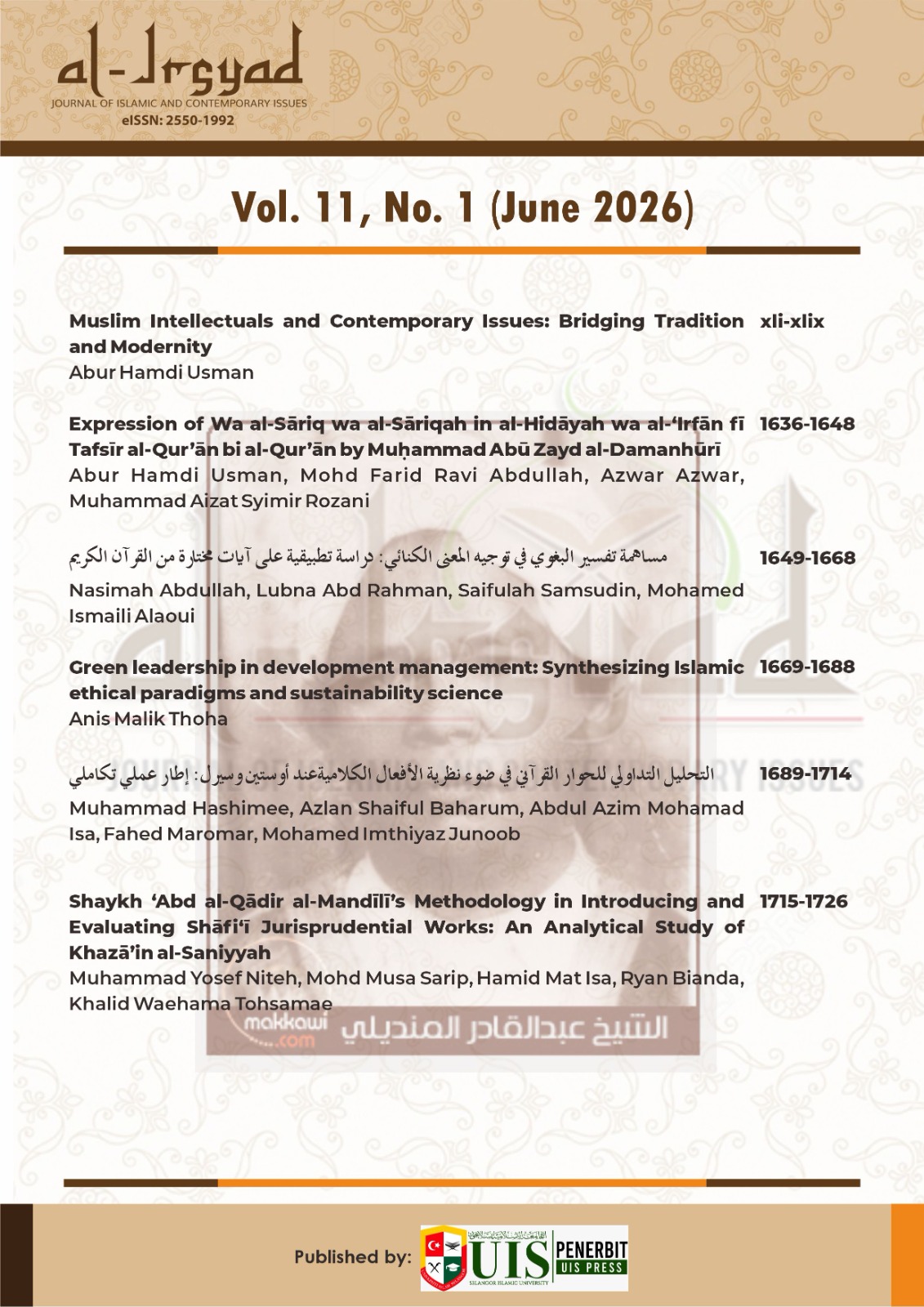
Muslim Intellectuals and Contemporary Issues: Bridging Tradition and Modernity
Intelektual Muslim dan Isu Kontemporari: Menjambatani Tradisi dan Kemodenan
DOI:
https://doi.org/10.53840/alirsyad.v11i1.624الكلمات المفتاحية:
Muslim Intellectuals، Contemporary Issues، Tradition، Modernityالتنزيلات
المراجع
Abdul Latif, F. B., Abdul Hamid, F. A., & Mohd Nor, M. R. (2012). Linking prophetic tradition to theological issues as discussed by Malay ulama’: A study on ʿAqidah al-Najin. Middle East Journal of Scientific Research, 12(3), 233-240. https://doi.org/10.5829/idosi.mejsr.2012.11.09.22707.
Abdul Malik, M. P., Abdul Hamid, F., & Abd. Rahim, M. R. (2025). Tradisi intelektual dalam tamadun Islam alam Melayu: Analisis kitab Melayu klasik abad ke-17 hingga ke-19. Journal of Al-Tamaddun, 20(2), 265-285. https://doi.org/10.22452/JAT.vol20no2.19.
Abdullah, N. (2017). Inaccuracies in the translation of the Quranic metonymy into the Malay language. Global Journal Al-Thaqafah, 7(1), 117-132. https://doi.org/10.7187/GJAT13220170701.
Abu-Rabi, I. (2008). The blackwell companion to contemporary Islamic thought. Blackwell Publishing.
Afsaruddin, A. (2015). Contemporary issues in Islam. Edinburgh University Press.
Ainusyamsi, F. Y., Munawar, M. A., Darisman, D., Munandar, D. S., & Husni, H. (2025). Interreligious engagement: Learning from the medieval Muslim intellectual legacy. Journal of Islamic Thought and Civilization, 15(1), 367-384. https://doi.org/10.32350/jitc.151.21.
Al Balushi, A. M. A., & Zeid, N. M. A. (2023). The jurisprudential approach of Imam Al-Baghawī in interpretation of the milestones of the revelation: Surah al-Baqarah as a model. Quranica, 15(1), 67-89. https://doi.org/10.22452/quranica.vol15no1.8.
Al-Ademi, K. K., & Al-Eryani, A. (2025). English-Arabic translation of speech acts: A comparative pragmatic analysis of King Lear. Centre for Applied Linguistics Research Journal, 12(1), 45-62. https://doi.org/10.60149/WLLA4466.
Aldekhan, M., & O’Neill, S. (2024). Intellectual meaning: An analysis of metonymy in English and Arabic. Eurasian Journal of Applied Linguistics, 10(3), 1-10. Retrieved from https://eric.ed.gov/?id=EJ1454662.
Awda, A. S. O., & Alani, A. A. H. (2025). Semantic influence on syntactic analysis in the Qur’an: A study of contextual overrides of grammatical norms. Dragoman, 19, 202-212. https://doi.org/10.63132/ati.2025.thebre.9631.
Bagatin, M. (2025). From ‘ilm al-naḥw to ma‘ānī l-naḥw in ‘Abd al-Qāhir al-Ǧurǧānī’s linguistic thinking. Language & History, 1-25. https://doi.org/10.1080/17597536.2025.2491211.
Baiza, Y. (2022). Are contemporary Islamic education and their pedagogical approaches fit for purpose? A critique and way forward. In Supporting Modern Teaching in Islamic Schools (pp. 17-30). Routledge. https://doi.org/10.4324/9781003193432.
Bamigbade, W. A., & Dalha, L. (2020). The pragmatics of the rhetorical question in selected (English) Qur’an chapters. Language and Semiotic Studies, 6(4), 103-125. https://doi.org/10.1515/lass-2020-060406.
Bardi, M. A. (2022). Towards a systemic functional description of the system of temporal values in Arabic. Word, 68(3), 277-316. https://doi.org/10.1080/00437956.2021.2003538.
Conti, V. (2022). The argumentative and rhetorical function of metonymy in an epidemic/pandemic context. In Forms and Uses of Argument (Vol. 13, pp. 81-104). Peter Lang. Retrieved from https://iris.unimore.it/handle/11380/1297205.
Dror, Y. (2021). Verbs of saying in the Qurʾān: The case of qāla. Al-Qantara, 42(1), 89-112. Retrieve from https://al-qantara.revistas.csic.es/index.php/al-qantara/article/download/625/628?inline=1.
Edis, T. (2009). Modern science and conservative Islam: An uneasy relationship. Science & Education, 18(6), 885-903. https://doi.org/10.1007/s11191-008-9165-3.
Edis, T., & BouJaoude, S. (2014). Rejecting materialism: Responses to modern science in the Muslim Middle East. In Matthews, M. (eds), International Handbook of Research in History, Philosophy and Science Teaching. Springer, Dordrecht. https://doi.org/10.1007/978-94-007-7654-8_52.
Farghal, M., & Alenezi, E. (2022). Arabic metonymy and synecdoche in English translation: The case of body parts. Jordan Journal of Modern Languages & Literatures, 14(4), 731-753. https://doi.org/10.47012/jjmll.14.4.2.
Habib, M. F. (2022). The quest for Islam and Muslim society: Late twentieth-and early twenty-first-century Muslim intellectual reflections on reform. The International Journal of Religion and Spirituality in Society, 13(1), 63. https://doi.org/10.18848/2154-8633/CGP/v13i01/63-78.
Haider, A., Mathlouthi, N., Nor, M. Z. M., Asmara, M., & Khan, A. (2026). From stewardship to sustainability: A comparative analysis of Islamic ecological jurisprudence and western anthropocentric regimes. JURIS (Jurnal Ilmiah Syariah), 25(1), 41-60. https://doi.org/10.31958/juris.v25i1.16040.
Hefner, R. W. (2014). Modern Muslims and the challenge of plurality. Society, 51(2), 131-139. https://doi.org/10.1007/s12115-014-9752-7.
Hosseini-Maasoum, S. M., & Radmard, A. (2015). The effect of tempo-spatial context on speech act analysis: Comparing the frequency speech acts in Meccan & Medinan surahs of holy Quran. Language Related Research, 6(3), 65-92. Retrieved from https://lrr.modares.ac.ir/article_6377_en.html.
Ikram, B., Wafa, Z., & Mimoune, C. E. (2025). Green sukuk and sustainable development goals: A strategic tool for Saudi Vision 2030 and the SDGS. Economic and Regional Studies, 18(3), 404-422. https://doi.org/10.2478/ers-2025-0029.
Kamaruding, M., Muis, A. M. R. A., Alias, M. S., & Mokthar, M. Z. (2025). Islamic leadership in construction project management: Conceptual foundations, practical challenges, and prospects. Multidisciplinary Reviews, 9(7), 2026313. https://doi.org/10.31893/multirev.2026313.
Kersten, C. (2010). New directions in Islamic thought: Exploring reform and Muslim tradition. Middle Eastern Studies, 46(4), 619-623. https://doi.org/10.1080/00263206.2010.492997.
Khazaleh, H. A. D., Sapar, A. A., Jan, J. M., Hussin, M., & Alaqad, M. H. (2025). Expressions of reassurance in the Quran: A speech act analysis. Southeastern Philippines Journal of Research and Development, 30(2), 103-117. https://doi.org/10.53899/spjrd.v30i2.846.
Kılınç, İ., Özçelik, G., Ertem, M., & Ünal, A. (2026). Green leadership: a scientific paradigm or a managerial fashion? International Journal of Organization Theory & Behavior, 1-12. https://doi.org/10.1108/IJOTB-11-2025-0352.
Littlemore, J. (2015). Metonymy: Hidden shortcuts in language, thought and communication. Cambridge University Press. https://doi.org/10.1017/CBO9781107338814.
Marcotte, R. D. (2012). Kari Vogt, Lena Larsen and Christian Moe (eds.), New Directions in Islamic Thought: Exploring Reform and Muslim Tradition. I.B. Tauris, London, 2009, pp. viii + 276, ISBN 978-1-84511-739-9 (Hbk). Journal for the Academic Study of Religion, 25(1), 79-80. https://doi.org/10.1558/arsr.v25i1.79.
Meuleman, J. (Ed.). (2005). Islam in the era of globalization: Muslim attitudes towards modernity and identity. Routledge.
Monady, H., Hasan, M., & Sagir, A. (2025). Building hadith authority: The pioneering role of Malay Archipelago scholars. Al-Bayan: Journal of Qur'an and Hadith Studies, 23(1), 73-100. https://doi.org/10.1163/22321969-20250167.
Moneim, Y. A. (2023). The green Islamic approach on environmental sustainability: A contemporary perspective. J. Int'l L. Islamic L., 19, 43. Retrieved from https://www.researchgate.net/publication/376523167_The_Green_Islamic_Approach_on_Environmental_Sustainability_A_Contemporary_Perspective.
Osman, M. N. M. (2025). Pathways to contemporary Islam: New trends in critical engagement. Routledge.
Parray, T. A. (2025). Perspectives on interpreting Islam in the contemporary Indo-Pak subcontinent: Issues and trends. Routledge.
Patmawati, P., Ma’u, D. H., Prasojo, Z. H., Istiqamah, I., & Nurrahmi, H. (2025). The history of the Malay fiqh development: An analysis of the manuscript Qawānīn al-Mubtadi’fī al-Fiqh work by Abdurrahman Husin al-Kelantani, Mufti of Amantubillah. Ulumuna, 29(2), 794-821. https://doi.org/10.20414/ujis.v29i2.1542.
Rahim, R., Rathore, H. S., Rabbani, M. R., & Alam, M. N. (2024). Maqasid Al-Shariah and green finance: A theoretical framework on Islamic finance with sustainable development goals for a greener future. In 2024 International Conference on Sustainable Islamic Business and Finance (SIBF) (pp. 255-261). IEEE. https://doi.org/10.1109/SIBF63788.2024.10883847.
Rodrigues, V. (2011). In search of an anchor: Muslim thought in modern India. Economic and Political Weekly, 46(49), 43-58. http://www.jstor.org/stable/41319458.
Sadek, G. (2026). Modernity and Islam: Overview of the place of reason in contemporary Islamic reformist thought. In Basalamah, S., Khalifa, A. W. (eds), Translating Modernity. Palgrave Studies in Translating and Interpreting. Palgrave Macmillan, Cham. https://doi.org/10.1007/978-3-031-92781-2_6.
Salama, A. H. (2021). Footing and speech acts in the Qurʼanic dialogue of Allah and Iblīs: A pragmatically enhanced approach. International Journal of Arabic-English Studies (IJAES), 21(2). https://doi.org/10.60149/WLLA4466.
Solimando, C. (2021). An innovative semantic approach to linguistic explanation: The case of Ibn Jinnīs Al-Khaṣā'iṣ. Rivista Degli Studi Orientali: XCIV, 2/4, 2021, 91-102. Retrieved from https://www.torrossa.com/en/resources/an/5122688.
Tanriverdi, S. (2021). Paths to Islamic modernities: The emergence of reformist American Muslim intellectuals and their dialectical engagement with modernity. Journal of Muslim Minority Affairs, 41(2), 299-316. https://doi.org/10.1080/13602004.2021.1943885.
Usman, A. H. (2025a). Voices of Muslim scholars: Navigating contemporary challenges in Islamic thought. Al-Irsyad: Journal of Islamic and Contemporary Issues, 10(1), xxi-xxix. https://doi.org/10.53840/alirsyad.v10i1.532.
Usman, A. H. (2025b). Islamic scholarship in the modern era: Contributions, critiques and innovations. al-Irsyad: Journal of Islamic and Contemporary Issues, 10(2), xxx-xli. https://doi.org/10.53840/alirsyad.v10i2.588.
Wachowski, W. (2019). How fundamental and ubiquitous really is metonymy? In Mianowski, J., Borodo, M., Schreiber, P. (eds), Memory, Identity and Cognition: Explorations in Culture and Communication. Springer, Cham. https://doi.org/10.1007/978-3-030-12590-5_11.
Weigelt, F. (2023). The historical stratification of the classical Arabic verb system. Zeitschrift für Arabische Linguistik, 78(2), 101-120. https://doi.org/10.13173/ZAL.77.1.036.
Yalçinkaya, M. A. (2019). Science, religion, and science-and-religion in the late Ottoman Empire. Zygon, 54(4), 1050-1066. https://doi.org/10.1111/zygo.12563.
Zarkasyi, H. F. (2019). The development of Islamic studies: A proposed model. Global Journal Al-Thaqafah, 9(2), 39-48. https://doi.org/10.7187/GJAT122019-4.
التنزيلات
منشور
إصدار
القسم
الرخصة
الحقوق الفكرية (c) 2026 Abur Hamdi Usman

هذا العمل مرخص بموجب Creative Commons Attribution-NonCommercial 4.0 International License.
License and Copyright Agreement
In submitting the manuscript to the journal, the authors certify that:
- They are authorized by their co-authors to enter into these arrangements.
- The work described has not been formally published before, except in the form of an abstract or as part of a published lecture, review, thesis, or overlay journal.
- That it is not under consideration for publication elsewhere,
- That its publication has been approved by all the author(s) and by the responsible authorities – tacitly or explicitly – of the institutes where the work has been carried out.
- They secure the right to reproduce any material that has already been published or copyrighted elsewhere.
- They agree to the following license and copyright agreement.
Copyright
Authors who publish with al-Irsyad: Journal of Islamic and Contemporary Issues agree to the following terms:
- Authors retain copyright and grant the journal right of first publication with the work simultaneously licensed under a Creative Commons Attribution License (CC BY-NC 4.0) that allows others to share the work with an acknowledgement of the work's authorship and initial publication in this journal.
- Authors are able to enter into separate, additional contractual arrangements for the non-exclusive distribution of the journal's published version of the work (e.g., post it to an institutional repository or publish it in a book), with an acknowledgement of its initial publication in this journal.
- Authors are permitted and encouraged to post their work online (e.g., in institutional repositories or on their website) prior to and during the submission process, as it can lead to productive exchanges, as well as earlier and greater citation of published work.
Licensing for Data Publication
al-Irsyad: Journal of Islamic and Contemporary Issues use a variety of waivers and licenses that are specifically designed for and appropriate for the treatment of data:
- Open Data Commons Attribution License, http://www.opendatacommons.org/licenses/by/1.0/(default)
- Creative Commons CC-Zero Waiver, http://creativecommons.org/publicdomain/zero/1.0/
- Open Data Commons Public Domain Dedication and License, http://www.opendatacommons.org/licenses/pddl/1-0/
Other data publishing licenses may be allowed as exceptions (subject to approval by the editor on a case-by-case basis) and should be justified with a written statement from the author, which will be published with the article.
Open Data and Software Publishing and Sharing
The journal strives to maximize the replicability of the research published in it. Authors are thus required to share all data, code, or protocols underlying the research reported in their articles. Exceptions are permitted but have to be justified in a written public statement accompanying the article.
Datasets and software should be deposited and permanently archived in appropriate, trusted, general, or domain-specific repositories (please consult http://service.re3data.org and/or software repositories such as GitHub, GitLab, Bioinformatics.org, or equivalent). The associated persistent identifiers (e.g. DOI, or others) of the dataset(s) must be included in the data or software resources section of the article. Reference(s) to datasets and software should also be included in the reference list of the article with DOIs (where available). Where no domain-specific data repository exists, authors should deposit their datasets in a general repository such as ZENODO, Dryad, Dataverse, or others.
Small data may also be published as data files or packages supplementary to a research article, however, the authors should prefer in all cases a deposition in data repositories.
كيفية الاقتباس